4 mm² or 6 mm² solar cable? How to size DC string cables
String current, cable length and allowed voltage drop decide the cross-section. A worked example, the formula and a quick table for 4 mm² and 6 mm² PV cable.
By Xinya editorial team
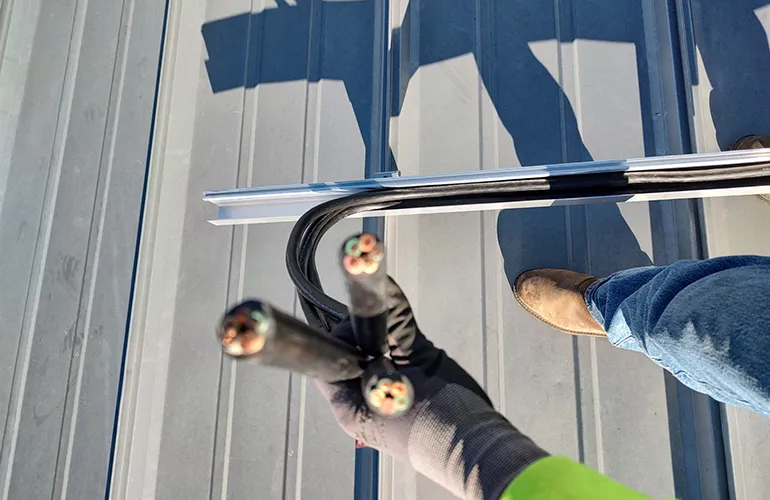
Most DC strings today are wired with 4 mm² or 6 mm² H1Z2Z2-K cable. The right size is the smallest one that passes two checks: current rating and voltage drop.
1. Current rating
Design for 1.25 × the module short-circuit current (Isc). EN 50618 gives about 55 A for 4 mm² and 70 A for 6 mm² (single cable in free air, 60 °C ambient). Even 15–18 A modules pass easily, so current rating rarely decides string cables — unless cables are bundled in hot trays, where derating factors apply.
2. Voltage drop
Voltage drop is what usually decides. For a string with one-way length L (m), current I (A) and string voltage U (V):
A = 2 × L × I × ρ ÷ (ΔU × U), with ρ ≈ 0.0227 Ω·mm²/m for tinned copper at 90 °C.
Example: a 1,000 V string, Isc 14 A (design current 17.5 A), 80 m one way, 1% allowed drop → A = 2 × 80 × 17.5 × 0.0227 ÷ (0.01 × 1,000) ≈ 6.4 mm². So 6 mm² gives about 1.06% and you would choose 6 mm², or 10 mm² for a 1% hard limit.
3. Quick rule
- Rooftop strings up to about 40 m one way → 4 mm²
- Longer runs, higher-current modules or strict 1% loss targets → 6 mm²
- Long string home-runs → consider 10 mm², or a combiner closer to the array
4. Don't forget
Use the same conductor size on plus and minus, keep cables out of standing water unless they are AD8-rated, and use connectors approved for your cable diameter.
Our online sizing tool runs both checks in seconds. Or send us your string data and route lengths — we return a cable schedule and quotation within one working day.